
Free Contractor Invoice Template & Generator
Create a professional contractor invoice in minutes. Add your labor, materials and permit fees, subtract any deposit, then download a PDF or email it to your client — free, with no sign-up and no watermark.
Invoice Generator
- Itemized labor, materials and permit lines
- Deposit and balance-due ready
- PDF, PNG and JPEG download, print or email
- Free PDF & Word contractor invoice templates
What Is a Contractor Invoice?
A contractor invoice is the bill a contractor sends a client to request payment for completed work. It lists the labor, materials and other costs of the job, shows any deposit already paid, and states how much is due and by when.
Contractor invoices are used by general contractors, builders and remodelers, and by trades such as electricians, plumbers, roofers, painters, landscapers and handymen. They are also called construction invoices, and the same format works for subcontractors billing a general contractor.
An invoice is different from a receipt: the invoice asks for payment, while a receipt confirms payment was made. Read receipt vs invoice for the full difference.
What to Include on a Contractor Invoice
A clear invoice gets paid faster and protects you if a job is ever disputed. Include these details:
| Section | What to include |
|---|---|
| Your business | Business name, address, phone, email and contractor license number |
| Client & job site | Client name and billing address, plus the job site address if it is different |
| Invoice details | Unique invoice number, invoice date, due date and project name |
| Labor | Description of the work, hours or days, and rate — or a fixed price per task |
| Materials | Materials and supplies used, with quantities and prices |
| Other costs | Permit and inspection fees, equipment rental, disposal and subcontractor charges |
| Tax | Sales tax as a separate line, where your state requires it |
| Payments | Deposits or progress payments already received, and the balance due |
| Terms | Due date, accepted payment methods, late fee and warranty notes |
How to Fill Out a Contractor Invoice
- Add your business details. Enter your company name, contact details and license number, and upload your logo.
- Add the client and job. Enter the client name, billing address and job site address, and give the project a name.
- Number and date it. Use a unique invoice number, today’s date and a due date.
- List the work. Add one line each for labor, materials, permits, subcontractors and any other costs.
- Add tax and discounts. Apply sales tax if your state requires it, plus any agreed discount.
- Subtract the deposit. Note any deposit or progress payment already received so the client sees the true balance due.
- Set terms and send. Add your payment terms and notes, sign it, then download the PDF or email it straight from the generator.
Contractor Invoice Example
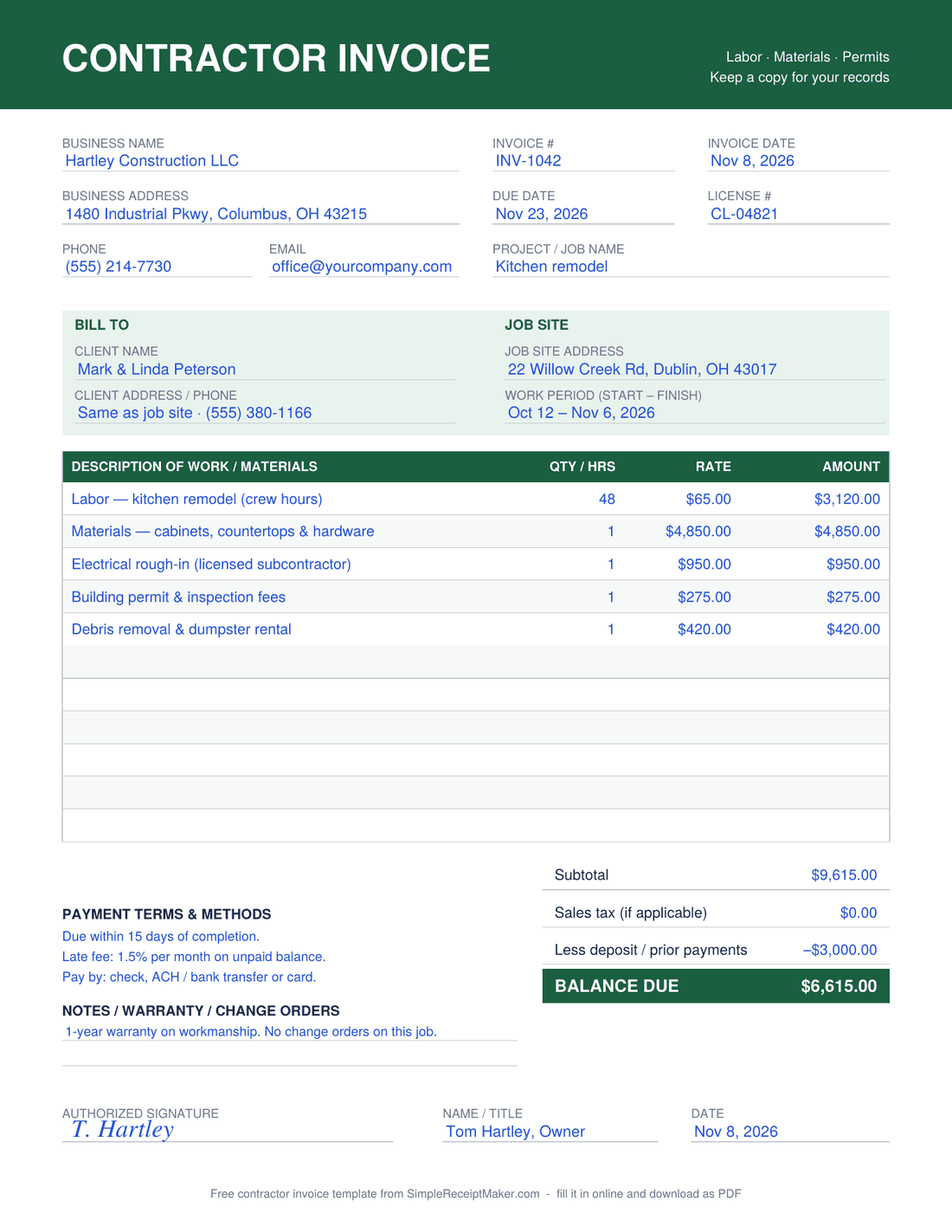
Here is a completed example for a kitchen remodel. The labor, materials, electrical subcontractor, permit and debris removal lines add up to a $9,615.00 subtotal. The client already paid a $3,000.00 deposit, so the balance due is $6,615.00.
Free Contractor Invoice Templates (PDF & Word)
Prefer to fill in an invoice by hand or in Word? Download our free contractor invoice template. It fits on one US Letter page and has space for your license number, the job site, 10 line items, sales tax, deposits, payment terms and a signature.
Want it typed, totaled and signed for you? Use the free contractor invoice generator at the top of this page instead.
Types of Contractor Invoices
General contractor and construction invoice
The standard invoice for a home improvement or building job. It itemizes labor, materials, subcontractors and permits, and usually subtracts a deposit taken before work began.
Subcontractor invoice
Sent by a subcontractor — such as an electrician or framer — to the general contractor rather than the property owner. Reference the general contractor’s project name or purchase order number so it is matched quickly.
Independent contractor invoice
Used by self-employed workers who bill a business for services. Clients who pay you $2,000 or more for services in 2026 will usually ask for your Form W-9 and may report the payments on Form 1099-NEC.
Progress billing invoice
On larger projects you bill in stages as work is completed — for example after demolition, rough-in and finish. Some commercial contracts hold back a percentage of each payment, called retainage (often 5–10%), until the job is complete. Show the amount withheld on each invoice.
Time and materials vs fixed price
A time and materials invoice bills actual hours and materials used. A fixed-price invoice bills the agreed contract price, plus any approved change orders listed as separate lines.
Tips to Get Paid Faster
- Send the invoice the day the job or phase is finished, while the work is fresh.
- Put an exact due date on it, not just “Net 30”.
- Take a deposit before starting, and show it clearly on the final invoice.
- List change orders as separate lines with the date they were approved.
- Accept more than one payment method, such as check, ACH and card.
- Keep a copy of every invoice and receipt for your taxes.
Frequently Asked Questions
Q: What should be included in a contractor invoice?
A: Your business name, address, phone and license number; the client name and job site address; a unique invoice number, invoice date and due date; an itemized list of labor, materials, permits and subcontractor costs; sales tax if your state requires it; any deposit already paid; the balance due; and your payment terms.
Q: Is a contractor invoice the same as an estimate?
A: No. An estimate (or quote) is sent before the work starts and shows what the job is expected to cost. A contractor invoice is sent after the work, or after a phase of it, and asks the client to pay for what was actually done.
Q: How do I show a deposit on a contractor invoice?
A: List the full cost of the job, then add a line such as “Less deposit received” with the amount as a negative number. The balance due is the subtotal plus any tax, minus the deposit and any earlier payments.
Q: Do I charge sales tax on a contractor invoice?
A: It depends on your state and the type of work. Some states tax materials, some tax certain construction services, and some tax neither. Check with your state revenue department or an accountant, and show any tax as a separate line.
Q: How do I invoice as an independent contractor?
A: Send an invoice with your name or business name, your client details, the dates and description of the work, your rate and total, and how you want to be paid. Clients who pay you $2,000 or more in 2026 for services will usually ask for a Form W-9 and may send you a Form 1099-NEC.
Q: What payment terms should a contractor use?
A: Common terms are “due on receipt”, “Net 15” or “Net 30”. Put the exact due date on the invoice, list the payment methods you accept, and state any late fee that is in your contract.
Q: Can I download this contractor invoice as a PDF?
A: Yes. Fill in the generator at the top of this page and click Download PDF, or download the free blank PDF and Word templates further down the page. There is no sign-up and no watermark.