
Invoice vs Receipt: What’s the Difference?
If you have ever sent a client an invoice and then wondered whether you also need to issue a receipt or vice versa, you are not alone. These two documents are frequently confused, yet they serve entirely different purposes at different stages of a transaction.
Understanding the difference between a receipt and an invoice is not just a matter of terminology. Using the wrong document at the wrong time can create confusion for your clients, complications for your bookkeeping, and problems during tax season.
This guide explains exactly what each document is, when to use each one, and how they work together in a professional business workflow.
What is an Invoice?
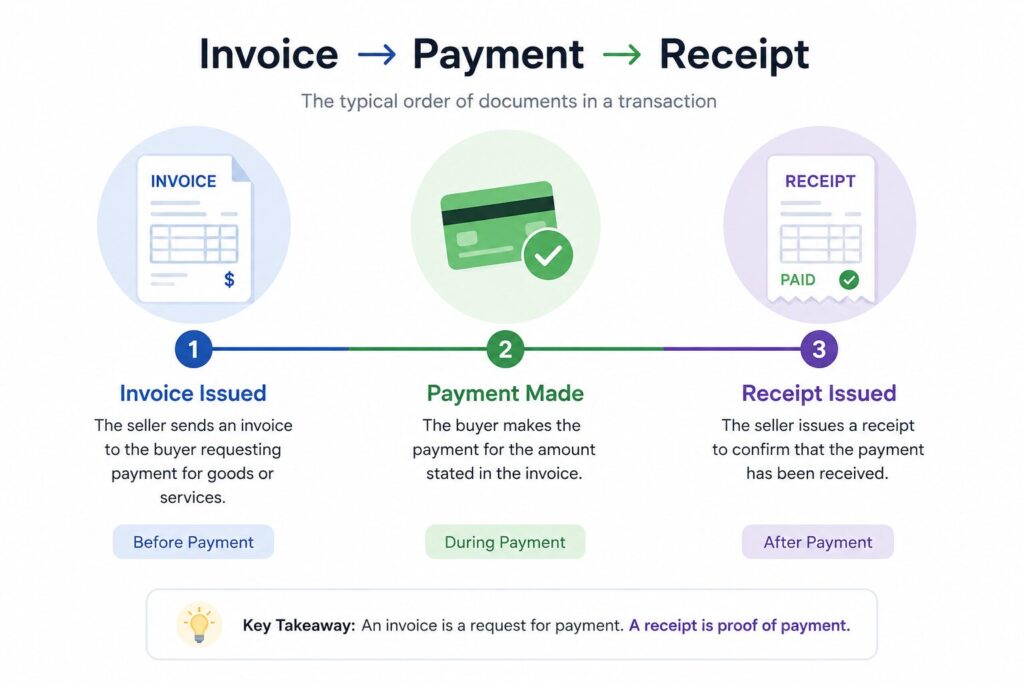
An invoice is a formal request for payment. It is issued by a seller or service provider to a buyer before payment has been made or at the point of delivering goods or completing a service.
An invoice says: “Here is what you owe me, and here is how to pay.”
It functions as a legally binding document that creates a payment obligation. Once a client receives an invoice, they are formally on notice that payment is due.
A professional invoice typically includes:
- The seller’s business name, address, and contact details
- The buyer’s name and contact details
- A unique invoice number
- The invoice date and payment due date
- An itemised list of goods or services provided
- Individual prices, quantities, and subtotals
- Tax rate and tax amount
- The total amount due
- Accepted payment methods and bank details
- Payment terms (e.g. Net 30, due on receipt)
What is a Receipt?
A receipt is a confirmation that payment has been received. It is issued by the seller after payment has been made not before.
A receipt says: “I have received your payment. Here is proof.”
It functions as a record of a completed transaction. Once a receipt is issued, the financial obligation created by the invoice is considered fulfilled.
A professional receipt typically includes:
- The seller’s business name, address, and contact details
- The buyer’s name
- A unique receipt number
- The date payment was received
- An itemised list of goods or services paid for
- The total amount paid
- The payment method used (cash, card, bank transfer)
- Tax amount collected
For a complete step-by-step guide on creating professional receipts, see our guide on how to make a receipt.
Invoice vs Receipt — Side by Side Comparison
| Feature | Invoice | Receipt |
|---|---|---|
| When issued | Before or at time of delivery | After payment is received |
| Purpose | Requests payment | Confirms payment was made |
| Payment status | Payment still outstanding | Payment completed |
| Issued by | Seller | Seller |
| Received by | Buyer | Buyer |
| Legal function | Creates a payment obligation | Proves the obligation was fulfilled |
| Used for | Accounts payable, chasing payment | Proof of purchase, tax records |
| Required fields | Due date, payment terms | Payment method, amount received |
Key Differences Explained
1. Timing
This is the most fundamental difference. An invoice comes before payment. A receipt comes after payment.
If you are requesting money, you need an invoice. If you are confirming money has been received, you need a receipt.
Getting this backwards creates problems. Sending a receipt before payment is received implies the transaction is complete when it is not. Sending an invoice after payment has already been made implies the bill is still outstanding when it is not.
2. Legal Purpose
An invoice creates a formal, legally enforceable debt. If a client refuses to pay, your invoice is a key piece of evidence in any dispute or legal claim. It establishes what was agreed, what was delivered, and what amount was owed.
A receipt, on the other hand, proves that the debt was settled. It protects the buyer by confirming they paid and protects the seller by documenting the income received.
3. What Happens to Each Document
Invoices go into a business’s accounts payable system (for the buyer) and accounts receivable system (for the seller). They are tracked until payment is made and then marked as paid.
Receipts go into expense records (for the buyer) and income records (for the seller). They are filed for tax purposes and used to verify transactions during audits.
4. Payment Terms
Invoices include payment terms, instructions about when and how to pay. Common terms include:
- Net 30: payment due within 30 days
- Net 15: payment due within 15 days
- Due on receipt: payment due immediately
- 50% deposit: partial payment required upfront
Receipts do not include payment terms because payment has already been made. They simply confirm what was paid and how.
5. Who Needs Each Document
Invoices are needed by:
- Freelancers billing clients for completed work
- Service businesses charging for ongoing work
- Suppliers delivering goods on credit
- Any business that does not collect payment at the point of sale
Receipts are needed by:
- Retail businesses completing point-of-sale transactions
- Landlords should issue a rent receipt after receiving monthly rent. This provides proof of payment for both the tenant and the property owner.
- Any business or individual accepting cash, needs cash receipt
- Employees claiming expense reimbursements
- Buyers needing proof of purchase for warranties or returns
- Restaurants issue restaurant receipts after customers pay for meals, while hotels provide hotel receipts for accommodation and business travel expenses.
- Any service business needs proof of payment after completing work — a tutor receipt, photography receipt, childcare receipt, cleaning receipt, mechanic receipt, repair receipt, Delivery service.
Sales Receipt vs Invoice
A sales receipt is simply a receipt issued at the point of sale — the customer pays and walks away with proof of purchase in the same moment. No invoice is ever raised, because no credit was ever extended.
That is the practical difference. An invoice exists because there is a gap between delivering something and being paid for it. A sales receipt exists because there is no gap at all. A shop, a café, a market stall and a taxi all issue sales receipts; a contractor who finishes a job and bills for it 30 days later issues an invoice, then a receipt when the money clears.
It is worth knowing that accounting software often treats “sales receipt” as a distinct transaction type, separate from “invoice”, precisely because the bookkeeping differs. An invoice creates a receivable that sits on your books until it is settled. A sales receipt records income and payment in one step, with nothing left outstanding.
Is an Invoice a Receipt?
No. An invoice is not the same as a receipt — an invoice is a request for payment, and a receipt is confirmation that payment was made. They are different documents created at different points in the same transaction, and one cannot silently stand in for the other.
The confusion is understandable, because the two often contain nearly identical information — the same business, the same customer, the same itemised list, the same total. What differs is what the document asserts. An invoice asserts that money is owed. A receipt asserts that money has been received. Handing a client an invoice after they have paid tells them, in writing, that they still owe you.
There is one narrow exception. A paid invoice — clearly marked as paid, showing the date payment was received and the method used — can function as a receipt, because it now records a completed transaction rather than an outstanding one. Most accounting software does this automatically when you mark an invoice as settled. If you are doing it manually, the word “PAID”, the payment date and the payment method all have to be on the document. Without them, it is still just an invoice.
Do You Need Both an Invoice and a Receipt?
Sometimes yes, and understanding when to issue both is important for professional business practice.
When You Need Only an Invoice
If your business invoices clients who pay later (Net 30, Net 15, or monthly billing), you may only need to issue an invoice. Once the client pays, you mark the invoice as paid in your accounting system. In this scenario, the paid invoice itself serves as the payment record, and a separate receipt may not be necessary.
When You Need Only a Receipt
For immediate cash or card transactions, such as a retail sale, a market stall, or a restaurant meal, the payment happens at the point of sale with no prior invoice. In this case, a receipt is all that is needed.
When You Need Both
In some business relationships, both documents are appropriate:
- A freelancer sends an invoice, the client pays, and then the freelancer issues a receipt to confirm payment was received
- A landlord may issue an invoice for monthly rent, then a receipt once the tenant pays
- A service business invoices for a large job and issues a receipt once the deposit or final payment clears
Issuing both provides a complete paper trail, the invoice shows what was owed and the receipt shows it was paid.
Where Is the Invoice Number on a Receipt?
Usually it is not there at all — and if you have been asked for an invoice number while holding a shop receipt, that is the most likely explanation.
An invoice number is created when an invoice is raised. If nobody ever raised an invoice, no invoice number exists. A supermarket, restaurant or petrol station receipt will instead carry a receipt number or transaction number, usually near the top or immediately below the total, sometimes alongside a till or terminal reference. For an expense claim, that number is almost always what is actually wanted; whoever designed the form simply labelled the field “invoice number”.
Where an invoice genuinely was issued — a supplier account, a tradesperson, a service contract — the receipt that settles it should quote the invoice number it relates to. That reference is what ties the two documents together, and it is the single most useful thing to include on a receipt for a business customer. If you are issuing receipts against invoices, put the invoice number on the receipt every time. It saves your customer reconciling by amount and date, which is where errors creep in.
Common Mistakes Businesses Make
Mistake 1: Using a Receipt as an Invoice
Some small business owners send a receipt and call it an invoice. This is incorrect. A receipt confirms payment already received. If payment has not yet been made, you need an invoice — not a receipt.
Mistake 2: Never Issuing Receipts
Many businesses only ever issue invoices and never follow up with receipts once payment arrives. This leaves clients without written confirmation that their payment was received, which can lead to disputes and confusion months later.
Mistake 3: Issuing Receipts Before Payment
Issuing a receipt before money has actually cleared implies the transaction is complete. If the payment later bounces or fails, you have no record that payment was still outstanding.
Mistake 4: Not Keeping Copies
Both invoices and receipts should be retained for tax purposes. Most tax authorities recommend keeping financial records for a minimum of three years. Keeping proper receipts is especially important if you are ever audited. Learn more in our guide on what happens if you get audited without receipts.
Invoice vs Receipt for Different Business Types
Freelancers and Consultants
Freelancers typically issue an invoice at the end of a project or on a monthly basis. Once the client pays, issuing a freelance receipt is good practice — it confirms the invoice has been settled and gives the client a clean record of the payment for their own accounting.
Retail Businesses
Most retail transactions involve no invoice at all. The customer selects products, pays immediately, and receives a receipt. The receipt is the only document needed.
Landlords
Landlords should ideally issue both. A monthly invoice reminds tenants what is due and when. A receipt issued after payment confirms it has been received. This two-document system prevents disputes and creates a clear payment history for both parties.
Service Businesses
Tradespeople, mechanics, cleaners, and other service providers often complete work first and bill later. An invoice documents what was done and what is owed. Once the client pays, whether by cash, card, or bank transfer, a receipt confirms the transaction is complete.
What Does “Due Upon Receipt” Mean?
“Due upon receipt” is a payment term meaning payment is expected as soon as the customer receives the invoice. Despite how it sounds, it has nothing to do with a receipt document — here “receipt” is used in its older sense of receiving something. It appears on invoices, never on receipts.
In practice it is the most aggressive of the common terms. Net 30 gives a customer a month, Net 15 gives a fortnight, and due upon receipt gives them no window at all. That makes it well suited to one-off jobs, new customers and small amounts, and poorly suited to corporate clients whose accounts payable systems run on fixed payment cycles and will simply pay you on their next run regardless of what the invoice says.
If you use it, make the deadline unambiguous by pairing it with a date rather than relying on the phrase alone. “Due upon receipt” invites the question of when receipt occurred; “payment due 14 March” does not.
How to Create a Receipt Instantly
Once a client pays your invoice, issuing a receipt should take less than a minute. Simple Receipt Maker is a free online tool that lets you generate a professional receipt with no signup and no subscription required.
Simply enter your business details, the transaction information, and the payment method, then download your receipt as a PDF, PNG, or JPEG instantly.
→ Create a free receipt now at Simple Receipt Maker
Frequently Asked Questions
Q: Can an invoice serve as a receipt?
A: Not automatically. An invoice is a request for payment, not a confirmation of it. However, if you mark an invoice as “Paid” and include the payment date and method, it can function as a combined invoice and receipt. Many accounting software tools do this automatically once payment is recorded.
Q: Which comes first, the invoice or the receipt?
A: Always the invoice first. The invoice requests payment. The receipt comes after payment has been made, confirming that the invoice has been settled.
Q: Do I need to issue a receipt if I already sent an invoice?
A: It depends on your business type and client preference. For professional service relationships, issuing a receipt after payment is good practice. For retail or cash transactions, a receipt is always necessary. When in doubt, issue both, it takes seconds and provides complete documentation for both parties.
Q: Is a receipt legally required?
A: Legal requirements vary by jurisdiction. In many countries, businesses are not legally required to issue a receipt for every transaction, though some regions require it for transactions above a certain value. Providing receipts regardless of legal obligation is considered best practice and protects both parties.
Q: Can I create a receipt without an invoice?
A: Yes. For immediate cash or card transactions, no invoice is needed beforehand. You can issue a receipt directly after payment is made without ever having sent an invoice.
Q: What is a proforma invoice?
A: A proforma invoice is a preliminary document sent before goods or services are delivered. It is not a formal payment request, it is more like a quote or estimate. A proper invoice is issued once the goods are delivered or the work is complete.
Q: What is a credit note?
A: A credit note is issued when a refund or credit is owed to a buyer, for example, if goods are returned or a service was unsatisfactory. It is essentially the opposite of an invoice, reducing the amount owed rather than requesting payment.
Summary
The difference between a receipt and an invoice comes down to timing and purpose:
- Invoice: issued before payment, requests money, creates a legal obligation
- Receipt: issued after payment, confirms money received, proves the obligation is fulfilled
Both documents are important tools for any business. Using them correctly keeps your finances organised, your clients informed, and your records audit-ready.
If you need to issue a receipt right now, Simple Receipt Maker makes it free and instant, no account needed, no watermarks, and no complicated setup.
→ Generate your free receipt at Simple Receipt Maker
Related Articles:
→ How to Make a Receipt: The Complete 2026 Guide
→ How to Send Receipts to Customers via WhatsApp
→ What Happens if You Get Audited and Don’t Have Receipts?
© 2026 Simple Receipt Maker | simplereceiptmaker.com