
Pet Care Receipt Generator — Grooming, Vet, Boarding and Training
Running a pet grooming salon, a boarding kennel, a dog training studio, or a veterinary clinic means you are in the business of caring for animals that people love like family. The paperwork side of that business deserves the same attention. Our free pet care receipt generator gives you four purpose-built templates covering every pet service setting — download as PDF or PNG instantly, no account needed.
Pet Care Receipt Generator
✓ Free ✓ No watermark ✓ No account needed
Receipt Style
Business Info
Receipt Info
Customer Info
Line Items
Charges & Taxes
Notes & Footer
Why Every Pet Care Business Needs a Proper Receipt
Most pet care providers think of a receipt as something they hand over because it feels polite. Their clients often need it for reasons that are far more practical.
Pet insurance is one of the fastest growing areas of pet ownership, and nearly every pet insurance policy requires itemized receipts or veterinary invoices before processing a claim. A receipt that lists only a single total is almost always rejected by an insurer’s claims team. A receipt that breaks down each service, each medication, and each fee as a separate line item goes straight through. The difference between those two documents is whether the pet owner gets reimbursed or has to cover the cost themselves.
Beyond insurance, pet care receipts matter for income records. A dog groomer who sees fifteen dogs a day and does not issue receipts has no paper trail. If their annual income is ever questioned by a tax authority, they have no documentation to fall back on. A receipt for every appointment is the simplest bookkeeping habit, a sole-trader pet care provider can build, and it costs nothing to maintain when the receipts are generated digitally.
For clients, a receipt is also a trust signal. A pet owner handing their dog over to a groomer or a boarding kennel for the first time is placing genuine trust in that business. A professional, itemized receipt confirms that the business takes its work seriously. It is one of the cheapest ways to build the kind of client confidence that turns a first-time visitor into a regular.
Generate Your Pet Care Receipt in Minutes
Our pet care receipt generator is built specifically around how pet services are actually billed. Each template reflects the real workflow of that service type — grooming services and coat notes for a groomer, drop-off and pick-up times and feeding instructions for a boarding facility, training methods and session homework for a dog trainer, and patient weight, vaccines, and rabies tag number for a vet clinic.
Fill in the fields, preview the receipt in real time, and download a finished PDF or PNG instantly. Every template supports logo upload, itemized line items, payment method, multi-currency, discount, tax, and digital or drawn signatures. The whole process takes under two minutes from opening the tool to downloading the file.
4 Pet Care Receipt Templates Built for Every Service
1. Pet Grooming Receipt
For dog groomers, cat groomers, mobile grooming vans, and full-service grooming salons. The Pet Grooming template uses a kraft-paper texture with a warm amber serif italic font and a decorative border, warm and inviting, suited to the personality of most pet grooming businesses that want to feel approachable rather than clinical.
What this template captures:
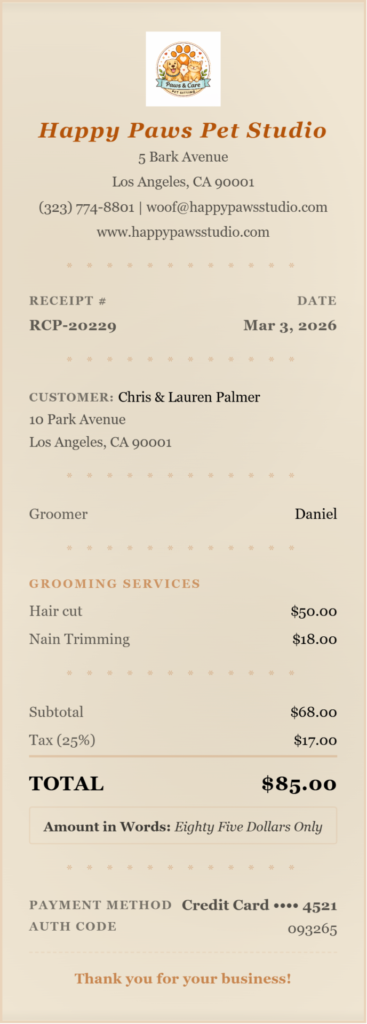
Pet name and breed: the receipt is tied to the specific animal, not just the owner. For grooming salons that see dozens of dogs a week, having the pet’s name and breed on the receipt makes it easy to match the document to the appointment record.
Size or weight class: small, medium, large, or extra large. Most grooming businesses price by size, so recording the size class on the receipt documents which pricing tier was applied. This prevents the kind of misunderstanding where a client remembers being quoted a price for a medium dog but their pet was assessed as large on the day.
Services performed: a written record of exactly what was done during the appointment. Bath and blow dry, full groom, nail trim, ear clean, teeth brushing, de-shedding treatment each service that was performed can be noted here so the client has a clear account of what they paid for.
Coat notes: a field to record any observations about the coat condition at the time of grooming. Matting, skin irritation, thinning patches, or any areas the groomer was unable to treat fully can be documented here. For groomers, this is protective. If a client later notices a skin issue and raises a concern, the coat notes on the receipt establish what was observed and disclosed at the time of the appointment.
Products used: the items section on this template is labeled “Products Used” rather than the generic line items heading. This makes the receipt read naturally for a grooming context where shampoo, conditioner, de-shedding treatment, and finishing spray are line items alongside the service fees.
Next appointment: displayed as a highlighted line at the bottom of the receipt. For grooming businesses that run on repeat bookings every four to eight weeks, having the next appointment printed on the receipt means the client leaves with the date in hand rather than needing a separate reminder message.
2. Pet Daycare and Overnight Boarding Receipt
For pet daycare facilities, overnight boarding kennels, dog hotels, and in-home pet sitters who offer multi-day stays. The Pet Daycare template uses a narrow thermal layout with a dotted separator — compact and functional, suited to a facility that processes multiple check-ins and check-outs daily and needs receipts that print fast and read clearly.
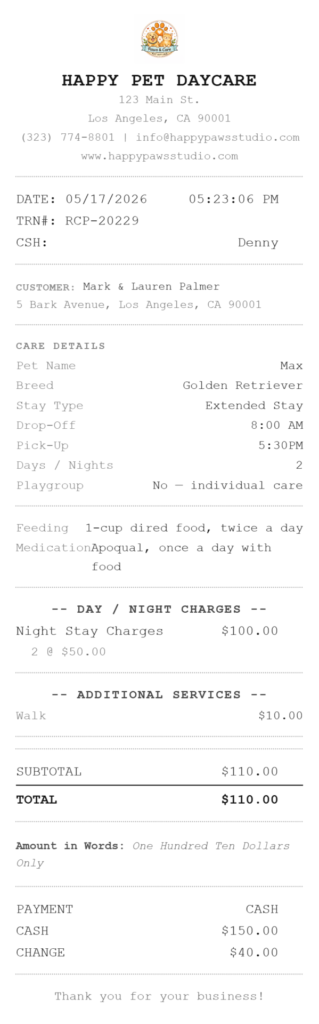
What this template captures:
Pet name and breed: ties the receipt to the specific animal in the same way as the grooming template.
Stay type: day care, overnight boarding, weekend stay, or extended stay. Recording the stay type on the receipt confirms which service category the billing applies to, which matters when a facility has different rate structures for different stay lengths.
Drop-off and pick-up times: both recorded on the receipt. For a pet owner submitting a boarding receipt to an employer for travel reimbursement, or simply wanting a record of when their pet was in care, having both times on a single document is genuinely useful. For the facility, the times protect against any dispute about whether a pet was collected on time or whether an additional day was charged correctly.
Days and nights: the total number of days and nights billed, displayed clearly so the client can verify the charge against the dates they booked.
Playgroup: whether the pet participated in group play during their stay, noted on the receipt. Some facilities charge extra for supervised playgroup sessions. Having it listed confirms the service was provided and that the charge is legitimate.
Feeding instructions and medication: both recorded on the receipt as a care record. If a pet has specific feeding requirements or is on medication during their stay, noting these on the receipt creates a lightweight care document that sits alongside the payment confirmation. For the owner, this is reassurance that the instructions were received and acknowledged.
Report card: a short italic note field at the bottom of the receipt for a behavioral report on the pet during their stay. Many boarding facilities send a separate report card, but for smaller operations, a brief note on the receipt itself covers the same ground. Clients love seeing that their pet was described as playful, settled well, or made friends during their stay.
The items section on this template is labeled “Day and Night Charges” — making the receipt read naturally for a boarding context where nightly rates, additional day charges, and add-on services each appear as line items.
3. Dog Training Receipt
For dog obedience trainers, puppy class instructors, behavioral consultants, and group training facilities. The Dog Training template uses a wide split-header layout with a navy blue accent on a clean white background, structured and professional, appropriate for a service that involves a formal training program with documented progress.
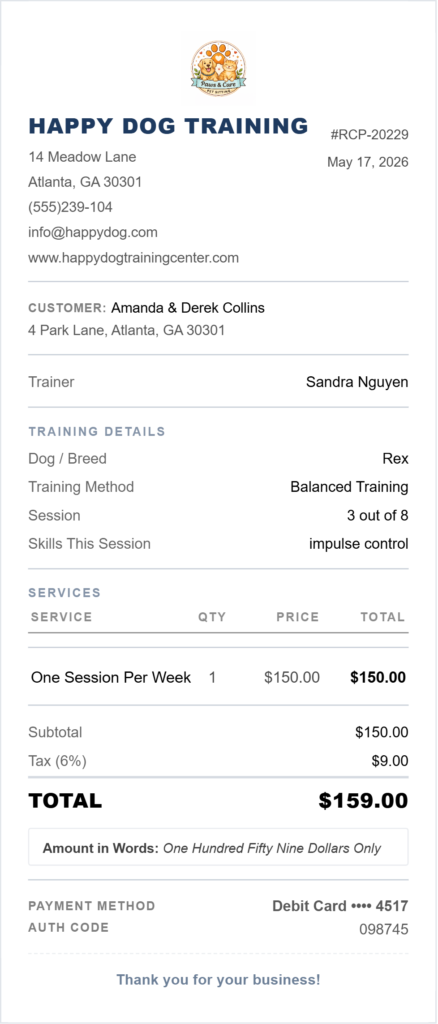
What this template captures:
Dog name and breed: the receipt is tied to the specific dog being trained, not just the client. For training programs where progress is tracked over multiple sessions, having the dog’s name on every receipt creates a consistent record across the course.
Training method: the approach used during the session, such as positive reinforcement, clicker training, e-collar conditioning, or behavioral modification. Recording the method on the receipt documents the professional approach taken and can be relevant if a client later consults another trainer or a veterinary behaviorist.
Session number: which session in the program the receipt covers. For a six-week obedience course, noting “Session 3 of 6” on the receipt tells the client exactly where they are in the program and makes the receipt useful as a program tracker as well as a payment confirmation.
Skills covered this session: a written record of what the dog worked on during the appointment. Sit, stay, recall, loose-lead walking, impulse control — noting the skills covered gives the client something concrete to take away and practice, and documents the content of the session for the trainer’s own records.
Homework: displayed as an italic note at the bottom of the receipt. Homework is the bridge between sessions in any dog training program. Printing it on the receipt means the client has a written reminder of what to practice before the next appointment, tied directly to the session they just paid for. It also demonstrates the trainer’s professionalism and investment in the dog’s progress between visits.
The items section is labeled “Training Services” on this template, which reads naturally for a session-based training context where group class fees, private session fees, and training aids each appear as separate line items.
4. Veterinary Clinic Receipt
For veterinary clinics, animal hospitals, mobile vets, and specialist practices. The Veterinary Clinic template uses a kraft-paper background with a green accent and an italic serif font, warm rather than sterile, which reflects the direction many modern veterinary practices are taking in their client-facing materials. The patient information section is headed “Patient Details” rather than the generic customer section heading used in other receipt types, immediately signaling that this document is tailored to a clinical context.
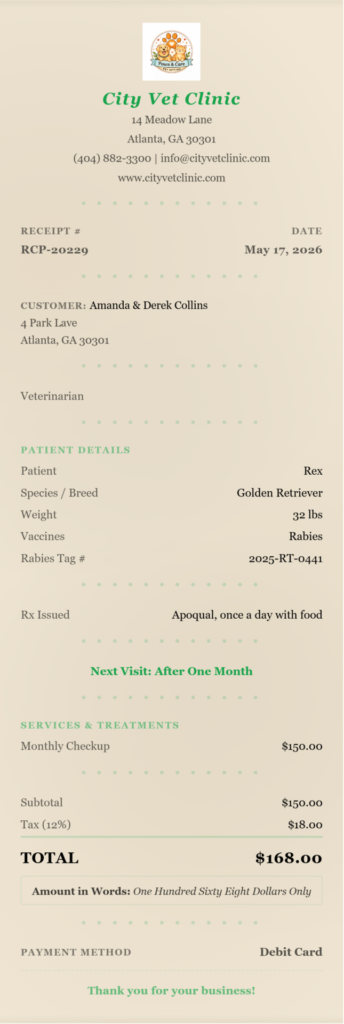
What this template captures:
Patient name: the pet’s name, displayed under “Patient” in the patient details section.
Species and breed: recorded together as a combined field. A cat receipt and a dog receipt from the same clinic look different in this field, and for multi-species practices, it is important that the receipt reflects the specific animal treated.
Weight: the patient’s weight at the time of the visit. Weight is recorded at nearly every veterinary appointment because it affects medication dosing, anesthetic calculations, and nutritional recommendations. Having it on the receipt means the client has a reference weight for that visit date, which is useful for tracking their pet’s health over time.
Vaccines administered: a written record of which vaccines were given during the appointment. For a client submitting a veterinary receipt to a pet insurance company, vaccine records on the receipt support the claim. For a client whose pet travels internationally or stays at a boarding facility that requires vaccination records, the receipt provides a secondary document alongside the official vaccination certificate.
Rabies tag number: displayed as its own field on the receipt. The rabies tag number is a legally significant piece of information in most jurisdictions. Having it printed on the receipt ties the payment record to the specific vaccination event, which matters for license renewals, international travel documentation, and any dispute about whether a pet’s rabies vaccination is current.
Prescriptions issued — any medications dispensed or prescribed during the visit, noted as a separate section on the receipt before the itemized charges. For pet insurance claims, prescription details on the receipt support reimbursement for medication costs. For the client, having the prescription name on the receipt gives them a reference when purchasing refills or seeking a second opinion.
Next visit: displayed as a highlighted line at the bottom of the receipt. Whether it is a follow-up appointment in two weeks or the next annual wellness visit, having the next visit date on the receipt means the client leaves with a concrete reminder without needing a separate recall postcard or text message.
The items section on this template is labeled with the standard heading, listing each service, consultation fee, procedure, vaccine, medication, blood panel as individual line items, which is the format most pet insurance companies require for claims processing.
What a Complete Pet Care Receipt Should Include
Regardless of which template you use, a well-formatted pet service receipt should always contain these elements to be useful for both the provider and the client.
Business name, address, and contact details — your legal trading name, physical address or service area, phone number, and email. For veterinary clinics and licensed grooming facilities, including your license number is worth doing. Clients who need to submit receipts to a pet insurer will be asked for provider contact details on the claim form.
Client name — the pet owner’s name, not just the pet’s name. The person filing an insurance claim or a tax deduction is the owner, so the owner’s name needs to be on the document.
Pet details — name, species, breed, and any relevant identifiers such as weight or rabies tag number. These fields are what distinguish a pet care receipt from a generic service receipt and are often required by insurance companies before a claim can be processed.
Receipt number and date — a sequential receipt number makes record-keeping straightforward for both parties. For clients with multiple pets visiting the same provider, the receipt number is how a specific transaction is identified if a query arises months later.
Itemized services and fees — every service, product, and fee listed as its own line item with an individual price. A single bundled total is rarely sufficient for insurance claims, FSA reimbursements where applicable, or employer expense submissions. Itemization is what makes a receipt genuinely useful beyond the moment of payment.
Payment method — cash, card, bank transfer, or app pay. For high-value veterinary bills especially, documenting the payment method protects the practice if a payment dispute arises and helps clients reconcile the charge against their bank statement.
Tax line — if you charge tax on pet services, the tax field lets you enter a rate and label it correctly. Sales tax rules on pet grooming and boarding services vary by state. For veterinary services, most states exempt medically necessary treatments but tax elective procedures differently. Documenting the tax correctly from the start makes end-of-period filing straightforward.
Pet Receipts and Pet Insurance Claims
When a pet owner files a claim, their insurer typically asks for a receipt or invoice that shows the provider’s name and contact details, the pet’s name and species, the date of service, a description of each service or procedure performed, and the individual cost of each item. A receipt that shows only a total — “Vet visit: $420” — will almost always be returned for more detail. A receipt that lists “Wellness exam: $65, Rabies vaccine: $28, DHPP vaccine: $32, Heartworm test: $45, Flea prevention 6 months: $89, Prescription ear medication: $78, Dispensing fee: $12” gives the insurer everything needed to process the claim without follow-up.
For grooming and boarding receipts submitted as part of a wellness or preventative care rider on a pet insurance policy, the same principle applies. Itemized receipts move through claims processing faster than summary receipts. Clients who receive itemized receipts from their pet care providers are less likely to need to contact the provider for additional documentation after the appointment, which saves both parties time.
The AVMA’s position on pet health insurance outlines what responsible pet insurance programs should provide, including transparency about coverage terms and support for the veterinarian-client-patient relationship. If your clients ask about pet insurance, this is a useful starting point for the conversation.
Frequently Asked Questions
Do pet insurance companies accept digital receipts?
Yes. Most pet insurance companies in the United States accept digital receipts submitted by email, through a claims portal, or as a PDF upload. The format matters less than the content. The receipt needs to show the provider’s name and contact details, the pet’s name, the date of service, and an itemized breakdown of every charge. A PDF generated by this tool meets all of those requirements and can be emailed to the client immediately after the appointment.
What is the difference between a veterinary receipt and a veterinary invoice?
A receipt confirms payment that has already been made. An invoice requests payment that is still outstanding. In a veterinary context, the terms are sometimes used interchangeably, but technically a receipt is issued after the client pays and an invoice is issued before. For pet insurance claims, most insurers accept either, provided the document is itemized and shows the date of service. If a claim is filed before payment is made, an itemized invoice typically suffices, with the receipt submitted once the balance is settled.
Can I use a dog grooming receipt for a pet insurance wellness claim?
It depends on the policy. Some pet insurance plans include a wellness or preventative care rider that covers routine grooming services such as nail trimming, ear cleaning, and dental care. If a policy includes these, the insurer will typically ask for an itemized receipt showing each service separately. A receipt that shows “full groom: $75” may not be sufficient if the wellness rider specifically covers nail trims and ear cleans but not bathing. Breaking each service into its own line item on the receipt gives the insurer the granularity needed to approve the relevant portion of the claim.
Do I need to include the pet’s breed on a boarding receipt?
Most boarding facilities include breed on their intake forms, but it is worth putting it on the receipt as well. Some boarding facilities have breed-specific pricing or size-based rate tiers. Having the breed on the receipt documents which tier applied. It also creates a useful secondary record of the pet’s identity alongside the payment, which can matter if a client later disputes which animal was in the facility’s care on a given date.
How should I issue receipts for a multi-pet household where two animals were treated or groomed in the same visit?
Issue a separate receipt for each animal. This is the cleanest approach for both your records and the client’s. Pet insurance policies are issued per animal, and a claim for one pet needs its own receipt. A combined receipt for two dogs seen on the same day can create confusion for an insurer trying to attribute charges to a specific policy. Our generator lets you fill in a new receipt quickly, so creating one per animal takes only a couple of minutes.
Does the dog training receipt work for group obedience classes billed per session?
Yes. The Dog Training template supports session-based billing. Enter the session number, the skills covered, and any homework assigned, and the receipt becomes a payment confirmation and a session summary in one document. For group classes where multiple dogs attend the same session, you would generate a separate receipt for each dog owner since each family is paying their own fee.
Can a boarding receipt be used to claim pet care as a business expense?
In limited circumstances, yes. If a pet is used in business a working dog at a farm, a dog used in a therapy program, or a pet used in commercial photography, boarding and care costs may be deductible as a business expense. The receipt would need to show the pet’s name, the dates of care, the services provided, and the amount paid. As always with tax deductions, the specifics depend on how the pet is used in the business and what your tax authority allows. An accountant who understands your business situation is the right person to advise on whether the deduction applies.
What should a mobile vet receipt include compared to a clinic receipt?
The core content is the same patient name, species and breed, weight, services performed, vaccines administered, rabies tag number, prescriptions issued, and itemized charges. The practical difference is that a mobile vet receipt should also include the service address, since the visit took place at the client’s home rather than at a fixed clinic. Including the service address confirms where the visit occurred, which can matter for insurance claims and for the client’s own records if they have multiple addresses.
Related Receipt Generators
Other free tools from Simple Receipt Maker