
Petty Cash Receipt Generator — Create a Petty Cash Voucher
Every business, from a two-person startup to a hundred-person office, runs into small expenses that are too minor to put through a formal purchase order but still need to be documented. That is exactly what petty cash is for and every time money leaves that fund, a written receipt needs to follow it. Our free petty cash receipt generator lets you create a professional petty cash voucher in under two minutes.
Petty Cash Receipt Generator
✓ Free ✓ No watermark ✓ No account needed
Receipt Style
Business Info
Receipt Info
Customer Info
Line Items
Charges & Taxes
Notes & Footer
What Is a Petty Cash Receipt and Why Does Every Business Need One?
A petty cash receipt, also called a petty cash voucher or a petty cash slip, is a written record of a single disbursement from a company’s petty cash fund. It documents who received the cash, how much was given, what it was for, and who authorized it.
Petty cash funds exist because writing a check or raising a purchase order for a $12 parking fee, a $6 roll of tape, or a $20 delivery tip does not make practical sense. Businesses keep a small amount of physical cash on hand typically between fifty and five hundred dollars depending on the size of the operation and use it to cover these minor day-to-day expenses without going through formal procurement.
The problem with cash is that it disappears silently if it is not documented. A petty cash receipt solves that problem by creating a paper trail for every dollar that leaves the fund. When you reconcile the fund at the end of the week or month, the total of all receipts should equal the total cash disbursed. If the numbers do not match, you know immediately that something needs investigating.
For a small business owner, the receipt is also an IRS requirement. The tax authority expects documentation for every business expense, including minor cash purchases. A properly filled petty cash voucher with the expense description, amount, date, and authorization is exactly what an accountant or auditor needs to verify that the disbursement was legitimate. Without it, small cash expenses become unsubstantiated deductions which creates risk at tax time.
For office managers and finance teams, petty cash receipts also protect the custodian who manages the fund. A custodian who can produce a signed receipt for every disbursement has clear evidence that the money went where it was supposed to go. Without receipts, there is no way to distinguish between a legitimate expense and a missing note.
Generate Your Petty Cash Voucher in Minutes
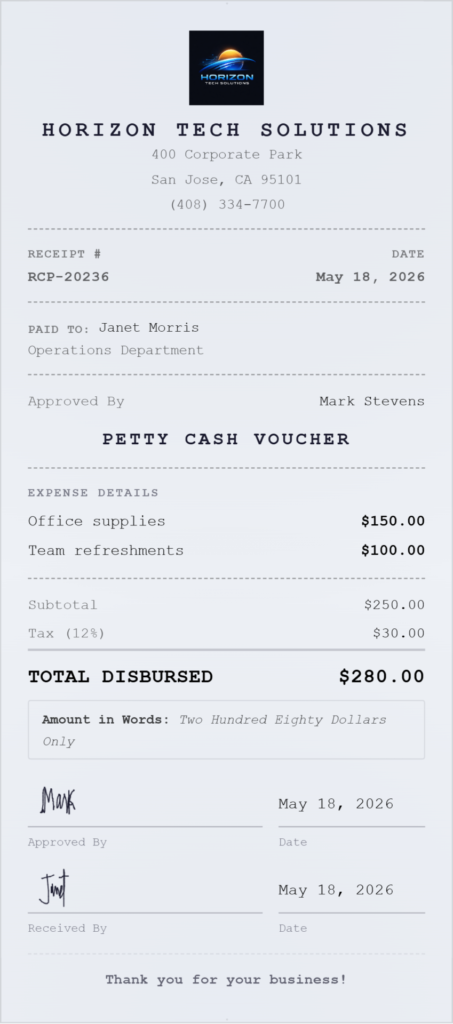
Our petty cash receipt generator is built around the real structure of a petty cash disbursement. It is not a generic receipt form with a heading changed. Every field reflects how petty cash actually works in practice from the company name at the top of the voucher to the “Approved By” and “Received By” signature lines at the bottom.
Enter your company name, the payee details, the expense description and amounts, the approver, and download a finished PDF or PNG instantly. The receipt uses a monospace font on a carbon-texture background with perforated edges the classic voucher aesthetic that accountants and auditors recognize immediately as a petty cash document. The whole process takes under two minutes.
Every voucher supports logo upload, itemized expense lines, tax field, amount in words, multi-currency, and dual signature lines. Download as PDF for printing and filing, or as PNG for digital expense records and accounting software uploads.
What the Petty Cash Receipt Template Includes
Company Information
The voucher opens with your company name displayed in bold uppercase lettering at the top of the document not a generic “Business Name” placeholder, but your actual organization’s name, formatted as it would appear on any official company document. Below the name sits your company address, which ties the voucher to a specific office or location for multi-site businesses where petty cash funds are maintained separately by department or branch.
Payee Information
The “Paid To” section records who received the cash. This is the employee name, vendor name, or individual who was reimbursed or paid directly from the fund. Below the payee name is a field labeled “Department or Purpose” which allows you to record either the department the expense belongs to, the cost center it should be allocated to, or a brief purpose statement if you prefer that approach for simpler operations.
For a small office with one shared fund, the department field typically holds the expense category. For a larger organization with multiple departments sharing a single petty cash policy, it records which department the disbursement came from so the accounting team can allocate it correctly during reconciliation.
Approved By
The approver field is one of the most important elements of a petty cash voucher — and the one most often left off informal slips. Every petty cash disbursement should be authorized by someone other than the person receiving the money. In most businesses that person is an office manager, department head, or finance controller.
Having the approver’s name on the voucher means there is a named individual accountable for every disbursement. If a discrepancy is discovered during reconciliation, the approver field immediately narrows down who authorized the transaction. This single field is what separates a document that can withstand an audit from one that cannot.
The Petty Cash Voucher Label
In the center of the receipt, the words “PETTY CASH VOUCHER” appear in uppercase bold lettering with wide letter-spacing. This heading is what distinguishes the document from a standard payment receipt. When a stack of vouchers is filed together, this label makes each one instantly identifiable without reading the surrounding detail.
Expense Details
The itemized expense section is where the actual disbursement is broken down. Each line item records a description and an amount. For a single-purpose disbursement — a postage run, a lunch delivery, a parking meter — one line is all you need. For more complex expenses where multiple items were purchased in one trip, you can add as many lines as necessary.
Common expense entries on a petty cash voucher include:
Office supplies such as pens, paper, and printer cartridges. Postage and courier fees. Refreshments for client meetings or staff events. Minor repair materials. Taxi or public transport fares for urgent tasks. Small cleaning or maintenance supplies. Delivery tips and gratuities. Incidental purchases that support the daily running of the office but do not justify a purchase order.
Each line is labeled under the heading “Expense Details” — which appears in small uppercase tracking above the item rows, making the section immediately clear to anyone reviewing the voucher.
Total Disbursed
Below the itemized lines, the voucher calculates and displays the total under the heading “TOTAL DISBURSED” — in bold, with a double rule above it separating it from the expense rows. This is the exact amount of cash that left the fund, and it is the figure that gets recorded in the petty cash log at the time of disbursement.
If a discount applies — for example, if the employee received a trade discount on supplies — the discount can be shown as a negative line item before the total, keeping the voucher accurate and transparent.
Amount in Words
Immediately below the total, the amount is displayed written out in full — for example, “One Hundred Fourteen Dollars and Seventy-Five Cents.” This field is surrounded by a light bordered box with italic styling, making it visually distinct from the numeric total above it.
Writing the amount in words is a standard practice on financial documents for a straightforward reason: it prevents alteration. A handwritten figure can be changed from $14.75 to $114.75 without much effort. A written-out amount cannot be altered without rewriting the entire line, which would be obvious to any reviewer. For petty cash vouchers that are filed physically and handled by multiple people, the written amount is a meaningful safeguard.
Approved By and Received By Signature Lines
At the bottom of the voucher are two signature lines: one for the approver and one for the recipient. These are labeled “Approved By” and “Received By” — the standard terminology for petty cash documentation in most accounting frameworks.
The approver signature confirms that the disbursement was authorized before or at the time the cash was handed over. The recipient signature confirms that the cash was received and that the amount shown on the voucher matches what was physically given. Both signatures together create a complete chain of custody for the disbursement.
You can add typed names, draw signatures directly in the browser, or leave the lines blank for physical signatures after printing. For most petty cash operations, printed vouchers signed by hand remain the standard practice because the voucher is physically filed alongside the receipts from the purchase.
Who Uses Petty Cash Receipts?
Petty cash vouchers are used by a wider range of organizations than most people expect. The most common users include:
Small and medium businesses that maintain a physical cash box for minor office expenses. The custodian — typically the office manager or receptionist — issues a voucher for every disbursement and files it alongside the original purchase receipt.
Schools and educational institutions where administrative staff cover minor expenses from a cash fund — replacement stationery, small event supplies, printing costs — and need to account for every disbursement to their finance department at the end of term.
Nonprofits and charities where petty cash documentation is often a grant compliance requirement. Funders may audit petty cash records as part of a program review, and a complete set of signed vouchers is the evidence that funds were used appropriately.
Corporate departments in larger organizations where each team maintains its own petty cash float separate from the central finance system. Department heads approve disbursements and the custodian reconciles weekly.
Healthcare practices, clinics, and veterinary offices where minor cash purchases — patient refreshments, cleaning supplies, small equipment items — are covered from a cash box that the practice manager reconciles monthly.
Remote and hybrid teams where an individual team member is issued a cash advance for a specific purpose, such as purchasing supplies for an off-site event or covering incidentals during a client visit, and needs to account for the spending with a formal voucher on return.
Petty Cash Receipt vs Petty Cash Voucher — Is There a Difference?
In everyday use, these two terms describe the same document. A petty cash receipt confirms that cash was disbursed and received. A petty cash voucher is the formal accounting name for the same slip. Whether a business calls it a receipt, a voucher, or a petty cash slip, the document serves the same function: it records a single cash disbursement from the fund with enough detail to justify the expense.
The only meaningful distinction some accounting frameworks draw is timing. In some systems, the voucher is filled out before the cash is handed over as an authorization document, and the receipt is issued after as a confirmation of payment. In practice, most small businesses use a single document for both purposes — the voucher is completed at the point of disbursement, signed by the approver and the recipient, and that single document serves as both authorization and confirmation.
If someone on your team searches for a petty cash voucher template, a petty cash slip, a petty cash form, or a petty cash reimbursement receipt — they are all looking for the same thing. The generator on this page covers all of them.
How to Manage Petty Cash Properly
A petty cash receipt is one piece of a broader system. The receipt documents an individual disbursement, but the fund only stays accurate if the receipts are part of a consistent management routine. Here is how most well-run petty cash systems work in practice.
Set a fixed fund amount. Most small businesses start with a petty cash float of between $100 and $300. This is the imprest amount — the balance the fund is always replenished back to at the end of each reconciliation period. Setting a fixed amount makes it easy to spot discrepancies: if the fund should contain $200 and you count $147, you know $53 is unaccounted for.
Issue a voucher for every disbursement without exception. The fund only stays balanced if every cash movement is documented. A $3 purchase with no voucher is a gap in the record. Over time, small undocumented amounts accumulate into real discrepancies that are difficult to explain.
Attach the original purchase receipt to the voucher. The voucher records the internal transaction — who received the cash and who approved it. The original purchase receipt proves that the money was spent on what the voucher says it was spent on. Filed together, they give you a complete record of the disbursement.
Reconcile regularly. Count the physical cash remaining in the fund and add it to the total of all outstanding vouchers. The combined figure should equal your imprest amount. Weekly reconciliation catches errors quickly. Monthly reconciliation works for low-volume funds. Whatever frequency you choose, be consistent.
Replenish by reimbursement, not by adding random amounts. When the fund runs low, raise a reimbursement request to your accounts team equal to the total of the vouchers filed since the last top-up. The fund is then brought back to its imprest amount by a check or bank transfer — not by adding cash from other sources without documentation.
The IRS requires businesses to keep records of all business expenses, including minor cash purchases. Petty cash vouchers are the documentation that supports those expense records. Most tax authorities recommend keeping expense records for at least three to seven years, and a complete set of dated, signed petty cash vouchers filed in chronological order is exactly what satisfies that requirement.
Frequently Asked Questions
Does a petty cash receipt need to be signed by both the approver and the recipient?
Best practice is yes. The approver signature confirms that someone in authority authorized the disbursement. The recipient signature confirms that the cash was physically received and matches the amount shown on the voucher. Together, the two signatures create a complete chain of custody that protects both the custodian and the approver if the disbursement is questioned during a review or audit. Some very small operations only use one signature, but two is the standard for any organization that takes financial controls seriously.
What is the difference between a petty cash voucher and a petty cash request form?
A petty cash request form is submitted before the disbursement — an employee fills it out to request cash for a specific purpose, and the approver signs it to authorize the release of funds. A petty cash voucher or receipt is completed at the time of disbursement or after — it records that the cash was actually handed over and received. Some organizations use both documents: the request form as a pre-authorization and the voucher as the confirmation. Others use a single document that serves as both. The generator on this page produces the disbursement receipt, which is the document that closes the transaction.
How long should petty cash receipts be kept?
The IRS generally recommends keeping business expense records for three years from the date of the tax return that included the expense — or up to seven years if you have claimed a loss or underreported income. Since petty cash vouchers are business expense records, they fall under the same retention guidance. In practice, most businesses file petty cash vouchers by month in a folder or binder and archive the folder at the end of each financial year. Digital copies created by downloading a PDF from this generator can be stored in a cloud folder and retained indefinitely at no cost.
Can I use a petty cash receipt for an expense reimbursement to an employee?
Yes. If an employee paid for a minor business expense out of their own pocket and is being reimbursed from the petty cash fund rather than through a formal expense claim, the petty cash receipt documents that reimbursement. Fill in the employee’s name in the “Paid To” field, describe the expense in the items section, and have both the approver and the employee sign the voucher. This is one of the most common uses of petty cash — covering incidental purchases that employees make on behalf of the business and are paid back immediately in cash.
Should petty cash vouchers be numbered sequentially?
Yes, and consistently. Sequential voucher numbers make it easy to verify that no disbursements are missing from the record. When you reconcile the fund, you can check that the voucher numbers are consecutive and that no gaps exist. Our generator produces receipt numbers automatically, but you can also enter a manual number if you want to maintain a specific numbering sequence that ties into your broader accounting records.
What expense categories typically come from petty cash?
The most common categories are office supplies and stationery, postage and shipping fees, refreshments and hospitality for meetings, minor cleaning and maintenance supplies, transport fares for urgent errands, small printing costs, tips and gratuities, and miscellaneous incidentals that support day-to-day operations. Most businesses set a per-transaction limit — commonly between $20 and $100 — and require that any single expense above that limit go through a formal purchase order rather than petty cash. Recording the expense description clearly on the voucher is what allows your accountant to allocate each disbursement to the correct expense category at the end of the period.
What happens if the petty cash fund does not balance during reconciliation?
The first step is to check all the vouchers against the log to confirm that every disbursement was recorded correctly and that no voucher totals were entered with arithmetic errors. Then confirm that every voucher has the corresponding original purchase receipt attached — a voucher without a receipt is documentation of a payment but not proof of what was purchased. If you still cannot reconcile the difference, you will need to record it as either a cash over or cash short entry in your accounts and investigate whether the discrepancy points to a recording error or a more serious issue. Regular weekly reconciliation makes these discrepancies smaller and easier to trace because the gap between the last balanced reconciliation and the current one is shorter.
Can the petty cash voucher be used for a cash advance to an employee?
Yes. Some organizations issue small cash advances to employees for anticipated expenses — covering travel costs for an off-site event, for example — before the actual purchases are made. In this case, the voucher documents the advance at the time the cash is handed over. When the employee returns, the original receipts are attached to the voucher and any unspent cash is returned to the fund. If the receipts total less than the advance, the difference is returned as change and noted on the voucher. If the receipts total more, the employee submits a top-up request for the difference. This approach keeps the fund balanced while giving employees the flexibility to handle variable expenses.
Related Receipt Generators
Other free tools from Simple Receipt Maker