
Donation Receipt Generator
Creates professional, tax-compliant donor receipts in under 60 seconds. Fill in the details, download as PDF, and share through whatapp or send email. Supports 501c3 receipts, church donation receipts, in-kind donation receipt, cash donation receipts, and more. All templates are completly free.
Donation Receipt Generator
✓ Free ✓ No watermark ✓ No account needed
Receipt Style
Business Info
Receipt Info
Customer Info
Line Items
Charges & Taxes
Notes & Footer
- PDF, JPEG & PNG download
- Share through Whatsapp or Send Email
- 6 donation receipt templates
- Tax-compliant
- Digital signature
What is a Donation Receipt?
A donation receipt is an acknowledgment issued by a nonprofit or charity confirming that they have received contribution. It documents the donor’s name, the amount or description of what was donated, the date, and the organization’s details. For donors, it serves as the official record needed to claim a tax deduction. For organizations, it’s a legal obligation.
Why Donation Receipts Matter for Taxes
The IRS requires a written acknowledgment for any single donation — cash or goods — of $250 or more. For donations under $250, you still need a bank record or receipt to claim the deduction, a simple thank-you note is not sufficient.
For non-cash donations (clothing, furniture, goods), the rules differ:
- Under $250: a receipt from the charity showing its name, the date and a description of the items (or your own reliable written record if getting a receipt isn’t practical, such as an unattended drop box).
- $250 to $500: a written acknowledgment from the charity, received by the time you file your tax return.
- Over $500 in total for the year: also file Form 8283 (Section A) with your return and keep records of how you got each item and how you valued it.
- Over $5,000 for one item or group of similar items: a qualified appraisal and Form 8283, Section B, generally signed by the charity.
New for 2026: Deductions Without Itemizing
Starting with the 2026 tax year, people who take the standard deduction can deduct up to $1,000 ($2,000 for married couples filing jointly) of cash gifts to qualifying public charities. Itemizers can only deduct the part of their giving that exceeds 0.5% of their adjusted gross income. Either way, keep a receipt for every gift. See IRS Publication 1771 and talk to a tax professional about your situation.
What a Donation Receipt Must Include
A donation receipt, to qualify for a tax deduction, it must contain:
- Name of the organization: The legal name of the nonprofit or charity
- Tax-exempt status: A statement that the organization is Tax exampte.
- Date of the donation
- Amount of cash donated: For cash/check/card donations
- Description of non-cash donations: Do not assign a value; donors are responsible for valuation
- A statement of whether goods or services were provided in return: If nothing was given in return, state: “No goods or services were provided in exchange for this contribution.”
Our generator automatically includes all required fields so you never have to worry about missing something. For the complete official guidance, see IRS Publication 1771 Charitable Contributions: Substantiation and Disclosure Requirements.
501c3 Donation Receipt — What Nonprofits Need to Know
If your organization is registered as a 501(c)(3) nonprofit, issuing a proper 501c3 donation receipt is not optional, it is a legal requirement for donations of $250 or more.
A 501c3 donation receipt differs from a regular receipt in one important way: it must clearly state your organization’s tax-exempt status and EIN (Employer Identification Number) so that donors can claim their charitable deduction on their tax return.
What a 501c3 Donation Receipt Must Include
A legally compliant 501c3 donation receipt must contain all of the following:
- Your organization’s legal name
- Your EIN (Employer Identification Number)
- A statement confirming your 501(c)(3) tax-exempt status
- The donor’s full name
- Date the donation was received
- Amount of the cash donation OR description of non-cash items
- A clear statement: “No goods or services were provided in exchange for this contribution” or if goods/services were provided, a description and fair market value estimate
Missing any of these fields can disqualify your donor’s tax deduction claim, even if the donation was genuine.
Important note: Only registered 501(c)(3) organizations can issue tax-deductible donation receipts. If your organization is not registered, donors cannot claim a tax deduction for their contribution. We recommend consulting a tax professional for guidance specific to your organization’s status.
How to Fill Out a Donation Receipt for Donated Goods
When you drop off clothing, furniture or household items at a thrift-store charity (such as Goodwill or the Salvation Army), you are often handed a blank or partly filled receipt. The charity confirms it received your items, but it does not value them — you fill in the value.
- Check the charity details: name, address and date should be on the receipt. Ask for the EIN if it is missing.
- List every item with a quantity and a short description, e.g. “3 men’s winter coats”.
- Note the condition. Clothing and household items must be in good used condition or better to be deductible.
- Add a fair market value for each item — roughly what it would sell for in a thrift store today, not what you paid.
- Total it and keep it with photos of the items. Over $500 in a year, you will also need Form 8283.
Our free printable donation receipt below includes a donated-items table with columns for quantity, condition and your estimated value.
Types of Donation Receipts We Support
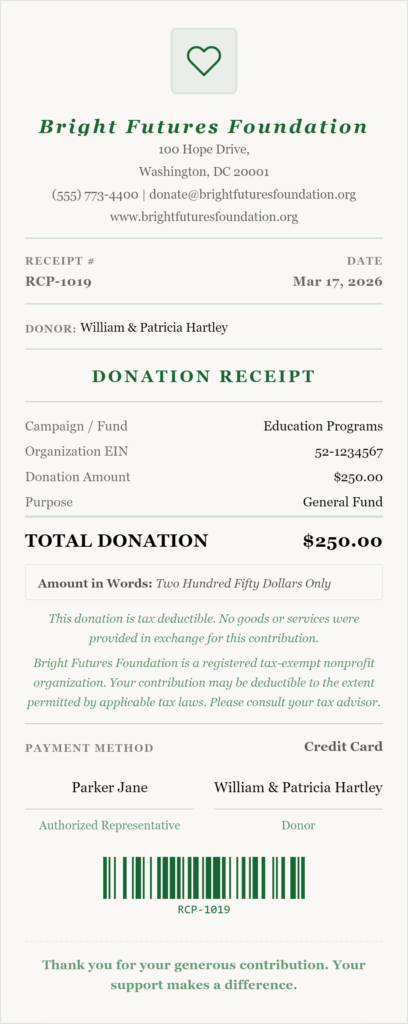
Monetary Donation Receipt
For monetary donations made by cash, check, credit card, or wire transfer. Includes amount, date, donor name, and organization details. This template can be used for Generic donations for any organization.
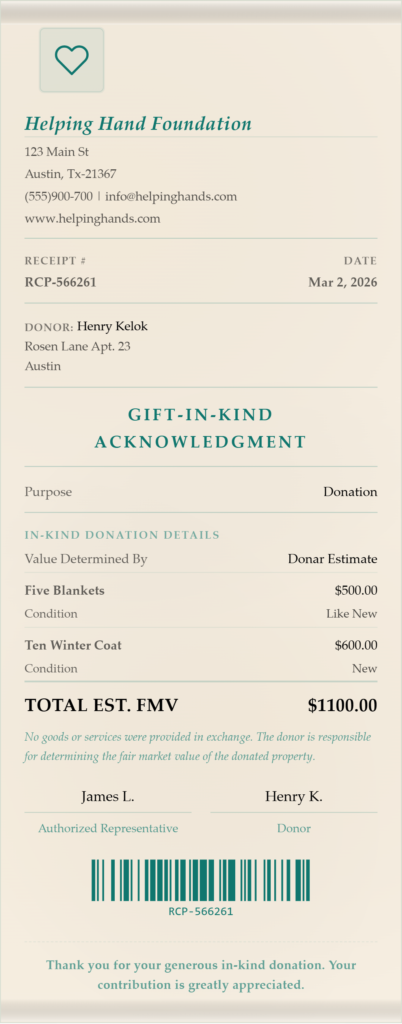
In-Kind Donation Receipt
For non-cash donations like clothing, furniture, electronics, or food. The receipt describes the items donated with fair market value (FMV) assigned by donor.
Nonprofit Donation Receipt
Specifically formatted for registered Nonprofit organizations. Includes the organization’s EIN, tax-exempt status statement, and the required disclosure language.

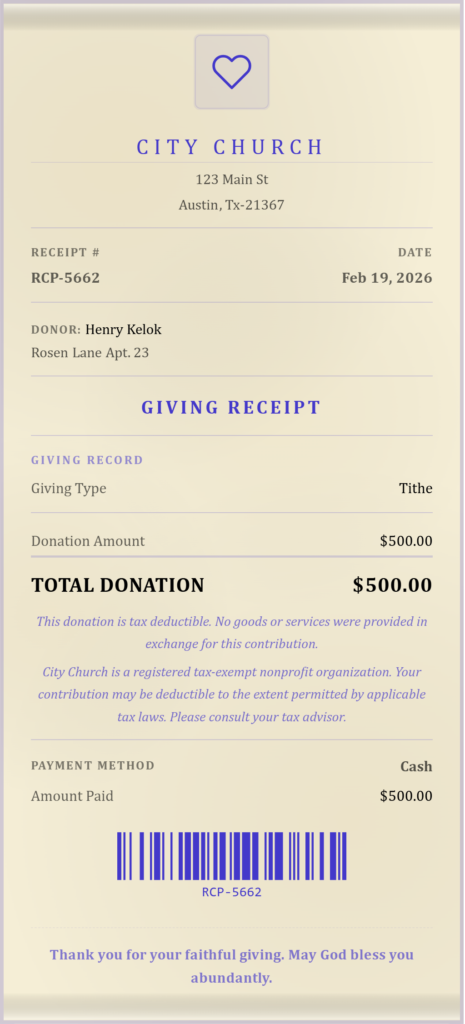
Church Donation Receipt
For congregational giving, tithes, or special offerings. Can be issued per donation or as a year-end summary for the donor’s tax records.
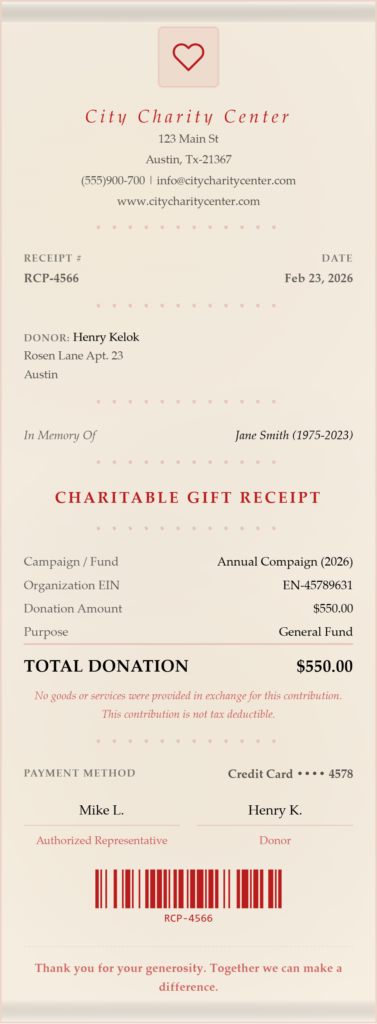
Charity Donation Receipt
For registered charities issuing charitable contribution receipts. Especially useful for Public charities, Fundraising campaigns, Tribute or memorial donations
How to use our Donation Receipt Generator (Step by step)
- Choose “Donation” under template on our toolpage
- Enter your organization’s details: name, address, EIN or tax-exempt number
- Enter the donor’s information: name and address
- Add the donation details: date, amount (for cash) or item description (for in-kind)
- Include the required disclosure statement: our tool does this automatically
- Download as PDF or PNG, or send directly by email
The whole process takes under two minutes.
Year-End Donation Receipt and Annual Donor Statement
Many organizations issue individual donation receipts throughout the year. But at the end of each tax year, sending a year-end donation receipt summary is also strongly recommended, especially for donors who give multiple times throughout the year.
What is a Year-End Donation Receipt?
A year-end donation receipt also called an annual donor statement or year-end contribution statement is a single document that summarizes all donations a person made to your organization during the calendar year.
It serves the same legal purpose as individual receipts and is especially useful for:
- Churches collecting weekly or monthly tithes
- Nonprofits with recurring monthly donors
- Schools receiving term-by-term contributions
- Any organization receiving multiple donations from the same donor throughout the year
What a Year-End Donation Statement Should Include
- Organization name, address and EIN
- Donor name and address
- List of all donations with individual dates
- Total amount donated for the full year
- Description of any non-cash donations
- Statement confirming no goods or services were provided in exchange
- Authorized signature
When to Send Year-End Donation Receipts
Best practice is to send year-end donation summaries by January 31st each year. This gives donors enough time to include their charitable contributions in their annual tax return before the filing deadline.
Note: Year-end donation statements are a summary tool and do not replace the requirement to issue individual receipts for donations of $250 or more at the time of the donation. Always consult a tax professional for advice specific to your organization.
Free Printable Donation Receipt Template (PDF & Word)
Need a paper receipt for a fundraiser, church collection or donation drive? Download our free donation receipt template. It has space for the organization’s name and EIN, the donor, a cash or non-cash contribution, the “no goods or services provided” statement the IRS asks for, an authorized signature, and a donated-items table.

Frequently Asked Questions
Q: Does a donation document to be on official letterhead?
A: No. While professional letterhead looks more credible, it is not legally required. What matters is that the receipt contains all required fields. Our generator produces a clean, professional receipt that satisfies all requirements.
Q: What is the maximum cash donation without a receipt?
A: Technically, there is no set maximum you can donate without a receipt, but if you want to deduct any cash donation, you need documentation. According to IRS, for donations of $250 or more, a formal written acknowledgment from the organization is legally required to claim the deduction.
Q: Do nonprofits have to provide an acknowledgements for every donation?
A: Nonprofits are legally required to provide written acknowledgment for donations of $250 or more. For smaller donations, it’s not legally required, but it’s strongly recommended as good donor relations practice.
Q: What is an in-kind donation acknowledgements?
A: An in-kind donation receipt acknowledges a non-cash contribution like clothing, furniture, food, professional services, or other goods. The receipt must describe what a person donated but should not assign a dollar value, since the IRS requires donors to determine fair market value themselves.
Q: Is a donation receipt the same as a donation letter?
A: Not exactly. A donation letter is typically a thank-you message that an organization send to a donor. A donation receipt is the formal document that proves the donation occurred and includes the specific details for tax purposes. Many organizations combine both into a single document called a receipt letter.
Q: What if the donor donates and goods and services were provided in return?
A: If your organization gave something back (a dinner ticket, merchandise, etc.), only the portion above the value of what was received is deductible. Your receipt must state the value of the goods/services provided and remind donors that only the excess is deductible.
Q: Does a church contribution need a receipt?
A: Yes! for any donation of $250 or more, a church must provide a written acknowledgment. Many churches send annual contribution statements at year-end, which serve this purpose. Our generator supports both individual and year-end church donation receipts.
Related Receipt Generators
Other free tools from Simple Receipt Maker
“This tool is designed to help generate receipts that meet common tax documentation requirements. For specific tax advice, consult a qualified tax professional.“