
Car Sale Receipt Generator — Create a Bill of Sale Instantly
Selling a car privately? You need more than a handshake. Our free car sale receipt generator lets you create a complete, professional bill of sale in minutes, covering seller details, buyer details, full vehicle information, purchase price, condition, lien status, odometer disclosure, and notarized signature lines. Download as a PDF or PNG instantly. No account needed, no watermark, completely free.
Car Sale Receipt Generator
✓ Free ✓ No watermark ✓ No account needed
Receipt Style
Business Info
Receipt Info
Customer Info
Line Items
Charges & Taxes
Notes & Footer
What Is a Car Sale Receipt and Why Does It Matter?
A car sale receipt also called a vehicle bill of sale or a used car receipt, is a written record of a private vehicle transaction. It documents who sold the car, who bought it, how much was paid, and the condition of the vehicle at the time of transfer.
People sometimes assume the title is enough. It is not. The title transfers legal ownership of the vehicle, but it does not record the agreed sale price, the odometer reading at the time of sale, known issues, payment method, or the condition the car was sold in. A car sale receipt captures all of that in a single document that both parties sign and keep.
For the seller, the receipt is protection. If the buyer later claims the car was misrepresented, or if there is a dispute over what was paid, the signed receipt is the evidence. For the buyer, the receipt supports any warranty claim, insurance registration, or title transfer process that requires proof of the sale price. Several states also use the declared sale price from a bill of sale to calculate the sales tax owed on the transaction, so accuracy matters from the start.
Use Our Free Car Sale Receipt Generator to Build Your Receipt in Minutes
Our car sale receipt generator walks you through every section of a proper vehicle bill of sale. Fill in the fields, preview the document in real time, and download a finished PDF or PNG the moment it looks right. There is nothing to install, no account to create, and no watermark on the file you download.
The template is built specifically for private party vehicle sales. It is not a generic receipt form with a few extra fields bolted on. Every section, from the odometer disclosure statement to the notary acknowledgment block, is included because it belongs on a proper car sale document, not because it fills space.
What the Car Sale Receipt Template Includes
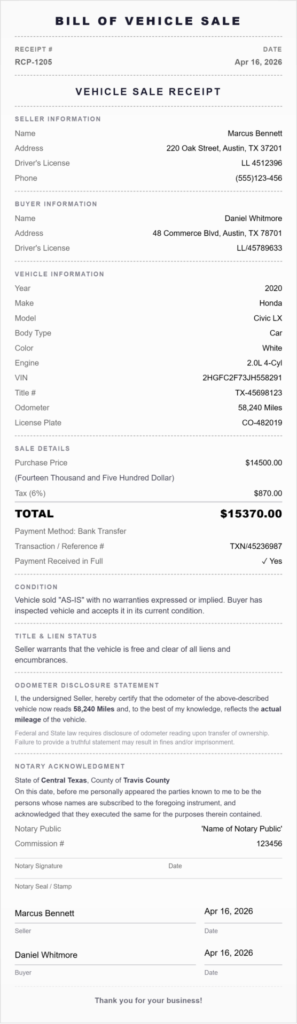
Seller Information
The receipt captures the seller’s full legal name, street address, driver’s license number, and phone number. Using a legal name rather than a nickname matters here, the name on the receipt should match the name on the title. If the names do not match, the buyer may face complications when registering the vehicle.
Buyer Information
The buyer section mirrors the seller section, full legal name, address, and driver’s license number. Both sets of identification details on a single document mean neither party needs to exchange separate copies of their license. The receipt is the record.
Vehicle Information
This is the most detailed section of the document and rightly so. The template captures:
Year, make, model, body type, color, engine specification, transmission type, VIN (Vehicle Identification Number), title number, current odometer reading, and license plate number.
The VIN is the most important field. It is the unique identifier that ties the receipt to the specific vehicle, not just a car of the same make and model, but that exact car. Anyone buying a used vehicle privately should confirm the VIN on the receipt matches the VIN stamped on the dashboard and on the title before signing anything.
Sale Price and Payment Details
The purchase price is entered as a number, and you can also enter the price written out in words, for example, “Twenty-Two Thousand Five Hundred Dollars and No Cents.” The written-out amount is a standard bill of sale convention that protects both parties against handwritten alterations to the numeric figure.
The template also handles partial payments. If the buyer is paying in installments, you can record the amount paid at the time of signing and the amount remaining, with both figures appearing clearly on the receipt. Payment method is recorded as well, cash, cashier’s check, bank transfer, or other, since the payment method matters for both parties’ financial records.
Vehicle Condition
The condition field offers three options: as-is, good, or excellent. Selecting “as-is” generates the standard as-is disclosure language directly on the receipt: the vehicle is sold with no warranties expressed or implied, and the buyer acknowledges they have inspected it and accept it in its current state. This language is important for private sellers who are not dealers and cannot be held to implied warranty standards.
If there are specific known issues with the vehicle, there is a separate field to record them, things like a cracked windshield, a check engine light, or worn brake pads. Writing these down at the time of sale closes the door on future claims that issues were hidden.
Title and Lien Status
This section addresses whether the vehicle is free and clear of liens or whether an outstanding loan balance remains. If the title is clear, the receipt states that the seller warrants the vehicle is free of all liens and encumbrances. If a lien exists, there is a field to record the lien details, typically the lender’s name and the loan reference. A buyer purchasing a vehicle with an active lien takes on responsibility for resolving it, and both parties should understand that before signing.
Odometer Disclosure Statement
Federal law requires sellers to disclose the odometer reading when transferring ownership of most motor vehicles. The odometer disclosure statement in this template is compliant with the federal requirement under the Truth in Mileage Act. You enter the reading, select whether it reflects actual mileage, whether the odometer has exceeded its mechanical limits, or whether there is a known discrepancy, and the corresponding legal statement is generated automatically on the receipt. The template also includes the standard federal warning that failure to provide a truthful odometer statement may result in fines or imprisonment. It is worth knowing that the odometer disclosure requirement was extended in 2021 to cover vehicles for their first 20 years up from the previous 10-year exemption, so most vehicles on the road today require a disclosure at the time of sale.
Notary Acknowledgment
Some states require a notarized bill of sale for vehicle transfers. Even where it is not required, having a notary acknowledge the signatures adds a layer of credibility to the document. The notary section includes fields for the notary’s name, commission number, and commission expiry date, along with a pre-formatted acknowledgment statement: “On this date, before me personally appeared the parties known to me to be the persons whose names are subscribed to the foregoing instrument, and acknowledged that they executed the same for the purposes therein contained.” Signature and stamp lines for the notary are included at the bottom of this section.
Seller and Buyer Signatures
Every car sale receipt generated with this tool includes a seller signature line and a buyer signature line with a date field beside each. You can add a typed name, draw a signature directly in the browser, or leave the lines blank for physical signatures after printing. Both parties signing the receipt is what converts a filled-in form into a binding agreement.
Who Needs a Car Sale Receipt?
The most common use is a private party car sale between two individuals, someone selling their personal vehicle directly to a buyer without going through a dealership. But the template works equally well for:
Truck and SUV sales, motorcycle transfers, RV and camper van sales, boat trailer transfers, classic and collectible car sales, family vehicle transfers where money changes hands, and fleet vehicle disposals where a company sells vehicles directly to employees or third parties.
Any time a motor vehicle changes ownership outside of a licensed dealership, a written receipt is the document that protects everyone involved.
What is difference between Car Sale Receipt and Bill of Sale?
In practice, these two terms describe the same document. A bill of sale is the formal legal name. A car sale receipt, used car receipt, and vehicle purchase receipt are all common informal names for the same thing. If you search for any of these and land here, the template covers everything a properly formatted bill of sale requires.
The one distinction worth noting is that some states have their own official bill of sale forms that include state-specific language or are required by the DMV as part of the registration process. The receipt generated here is suitable for use in a private transaction and as a supporting document for registration purposes, but you should check your state’s DMV website to confirm whether a state-specific form is also required alongside it. The FTC’s used car resource hub is a good starting point for understanding what buyers and sellers should document at the time of a private sale.
Frequently Asked Questions
Q: Do I need a car sale receipt if I already have the title?
A: Yes. The title proves ownership but it does not record the terms of the sale. It does not show the sale price, the odometer reading at transfer, the payment method, the condition agreed upon, or any known issues. A receipt captures all of that. In some states the sale price declared in the bill of sale is also used to calculate the buyer’s registration tax, so a missing or inaccurate document can cause real problems at the DMV.
Q: Is a car sale receipt legally binding?
A: A signed car sale receipt is a legally binding contract between the seller and the buyer. It records the terms both parties agreed to at the time of the transaction. If either party later disputes the sale price, the condition of the vehicle, or the payment, the signed receipt is the evidence that establishes what was agreed. The odometer disclosure statement carries additional legal weight, falsifying it is a federal offense under the Truth in Mileage Act.
Q: What should a used car receipt include?
A: A complete used car receipt should include the seller’s full name, address, and driver’s license number; the buyer’s full name, address, and driver’s license number; the vehicle year, make, model, VIN, odometer reading, and title number; the agreed sale price written as both a number and in words; the payment method; a statement of the vehicle’s condition; a lien disclosure; the odometer disclosure statement; and signatures from both parties with dates. The template on this page includes all of these fields.
Q: Does the receipt handle partial payments or installment arrangements?
A: Yes. If the buyer is not paying the full amount upfront, you can record the amount paid at the time of signing and the amount remaining. Both figures appear clearly on the receipt. This is particularly common in family or friend transactions where the payment is spread over time.
Q: What is an odometer disclosure statement and do I need one?
A: An odometer disclosure statement is a federally required declaration of the vehicle’s mileage at the time of sale. Under the Truth in Mileage Act, sellers of most motor vehicles are required to disclose the odometer reading when transferring ownership. Vehicles over ten years old are generally exempt. The disclosure also requires the seller to state whether the reading reflects actual mileage, whether the odometer has exceeded its mechanical limits, or whether there is a known discrepancy. The receipt generator produces the correctly worded statement automatically once you enter the reading and select the accuracy option.
Q: Do I need to have the receipt notarized?
A: It depends on your state. Some states require a notarized bill of sale for vehicle title transfers. Others do not require it but many people choose to notarize regardless, since a notarized document is harder to dispute. The receipt includes a complete notary acknowledgment section with fields for the notary’s name, commission number, and expiry, you can include it or skip it depending on your state’s requirements.
Q: Can I use this for a motorcycle, RV, or truck sale?
A: Yes. The template works for any private motor vehicle transaction. The vehicle information section captures body type, engine, and transmission, which covers everything from a motorcycle to a pickup truck to a motorhome. The legal language throughout the document refers to “vehicle” rather than “car” specifically, so it applies to any motor vehicle sale.
Q: What if the car has an existing loan, can I still use this receipt?
A: Yes. The lien status section lets you record whether the vehicle is free and clear or whether an outstanding loan exists. If a lien exists, you can record the lender details. Buyers purchasing a vehicle with an active lien should understand that the loan does not disappear with the sale, it needs to be resolved either before or as part of the transaction. Recording the lien details on the receipt ensures both parties are clear on the situation at the time of signing.
Q: What payment methods does the receipt support?
A: The receipt records the payment method used, cash, cashier’s check, bank transfer, wire transfer, personal check, and others. For high-value private vehicle sales, cashier’s checks and bank transfers are the most common methods of payment. Since they provide a clear paper trail. The receipt records whichever method you use.
Q: Can both the seller and buyer sign the receipt digitally?
A: Yes. The template includes signature blocks for both the seller and the buyer with date fields. You can type a name, draw a signature directly in the browser, or print the completed document and sign it by hand. If you are having the receipt notarized, you will typically sign it in front of the notary.
Related Receipt Generators
Other free tools from Simple Receipt Maker